Bel Canto Design e.One REF600M – Prova completa di Stereophile (ottobre 2016)
È disponibile in formato PDF la prova completa di Stereophile (ottoblre 2016) degli amplificatori Bel Canto Design e.One REF600M

È disponibile in formato PDF la prova completa di Stereophile (ottoblre 2016) degli amplificatori Bel Canto Design e.One REF600M
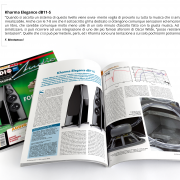
“Quando si ascolta un sistema di questo livello viene ovvia- mente voglia di provarlo su tutta la musica che si ama, intento ovviamente irrealizzabile. Anche con le 7-8 ore che il sottoscritto gli ha dedicato si ottengono comunque sensazioni ed emozioni sufficienti a scrivere un libro, che sarebbe comunque molto meno utile di un solo minuto d’ascolto fatto con la giusta musica. Ad ogni modo, dovendo sintetizzare, si può ricorrere ad una integrazione di uno dei più famosi aforismi di Oscar Wilde, “posso resistere a tutto, fuorché alle tentazioni”. Quelle che ci si può permettere, però, ed i Kharma sono una tentazione a cui solo pochissimi potranno non resistere.”
F. Montanucci
Clicca qui per leggere la prova (formato PDF)


There are certain brands that exist somewhere in the hi‑fi firmament, visible to all but attainable by very, very few. These objects of desire, so often at the centre of vociferous debate, are (seemingly inevitably) loved by some and loathed by others. But most such arguments are ultimately both spurious and pointless, as the protagonists lack both the funds and the hands‑on experience to reach conclusions that matter. It’s a little like motorsport enthusiasts discussing whether they’d rather have Nico Rosberg or Daniel Ricciardo in their Formula 1 team. Unless one of those motorsport fans is a billionaire wanting to be a millionaire, it’s idle dreaming.
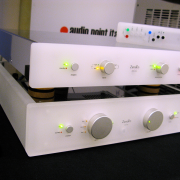
One of the first names on the Audio Unobtainables dream team sheet would be Zanden. With products that regularly feature on audiophile’s “what if” wish lists – and with prices to match – the brand qualifies on all counts. The company’s most revered product is probably the Model 1200 Mk III phono‑stage, a two‑box unit that offers two inputs, switchable gain and five different replay EQ options – at a price that’s five‑pence short of £24K! Then there’s the (slightly) more affordable Model 1300: same facilities, single‑box, and a mere £13.5K – not exactly pocket money. Which brings us to the Model 120, a product that looks every inch a Zanden. It’s a Zanden thanks to that slim, square footprint, chromed chassis, and external power supply. Also, the four controls equally spaced across the frosted acrylic front‑panel and, perhaps more than anything else, those five different replay EQs make it unmistakably a Zanden product; one of a rare breed of products hailing from the gifted pen of Yamada‑san. Yet the Model 120 tips the financial scales at a “mere” £7,495; not exactly chicken feed, but positively cheap by Zanden standards.
This is where cynicism tends to kick in, with the obvious question being, what’s been left out? If the boxes look pretty much the same and all the facilities and functions are in place, what corners have been cut and where? If the Model 120 really is going to be the Volks‑Zanden to the 1200’s Mercedes SLS or the 1300’s AMG GT, then it needs to do more than just look the part – it needs to deliver Zanden performance too. Look a little closer and what you discover is that this is actually a typically thoughtful and carefully considered design that’s cut its cloth with considerable skill in order to also cut its costs. The first indicator comes in the shape of the compact external supply. It’s nicely finished, but with its through‑box format, it’s clearly designed to be tucked away out of sight – unlike the power supplies on Zanden’s more ambitious products. Given that the Model 1300 is a one‑box unit, you might well wonder why the 120 has an external supply in the first place? Look under the lid and you’ll find your answer. Unlike its bigger brothers, the 120 is an entirely solid‑state design, which necessites a separate PSU to remove stray electro‑magnetic fields. Going valve-free is not the show‑stopper you might think, thanks to the brand’s extensive experience with solid‑state and hybrid circuitry. In fact, the retention of Zanden’s LCR topology is arguably more critical. Explaining ‘LCR’ can get a little confusing; capacitance (‘C’) and resistance (‘R’) are obvious, but ‘L’ is short for ‘inductance’, in honour of the electrical pioneer Heinrich Lenz. You can’t use ‘I’ here, because that is already used to denote ‘current’. Incidentally, inductance (L) is measured in H (henry), while current (I) is measured in A (ampere) – put them together and you can spell ‘hail’!

The Model 120 is equipped with two, independently switchable inputs, one single‑ended (RCA) and one balanced (XLR), although users can order it with two single‑ended inputs at no extra cost. Outputs are single‑ended only.
The front panel is an object lesson in minimalism. Working from left to right, there’s a push button for on /off, followed by a four position rotary control that combines input selection and cartridge load. This matches the ‘high’ or ‘low’ impedance requirements of the cartridge, each setting having its own pair of Jensen step-up transformers – ‘low’ impedance has 73dB of gain, and ‘high’ 63dB. The next rotary control selects the five EQ curves and the final push button switches absolute phase. All the selections are indicated by small, traffic light LEDs. There really should be no excuse for leaving the unit set to the wrong phase, EQ, or load, while for me, the acrylic front panel, matt controls and sharp LEDs make this the best looking of a notably attractive line. With all the functional versatility that makes the more expensive Zanden phono‑stages so capable and appealing, the Model 120 has all the physical attributes to become a firm favourite – especially given its more approachable price.
Time then, to talk musical performance and define where the 120 sits relative to its more illustrious brethren. If the 1300 trades away some of the 1200’s remarkable tonality and dimensionality, harmonic and acoustic coherence in return for a crisper, more energetic sound with more obvious dynamic authority, it’s tempting to assume that the 120 extends that continuum. In fact, it sits rather neatly between those two schools. It is softer and less emphatic than the 1300, without the remarkable sense of shape and space that comes from the flagship. In the context of products with five‑figure price‑tags, that makes it neither fish nor fowl: less precise than some, less warm than others. What that means is that you don’t get a Model 1300 for around half the price – which is exactly why the 1300 is in the Zanden family! Play the Zanden Model 120 in systems constructed from among its price peers, and you start to realise just what a cannily balanced product it is. It was particularly impressive paired with the Rowland Capri S2 pre and Model 125 power amplifiers. Here, the 120’s subtle softening took the edge off the Rowland’s laser‑cut resolution and transparency, while its sense of temporal integrity and rhythmic coherence gave music a real sense of life, bounce, and flow; a musical dovetail that immediately elevated all the products involved. The Zanden is also one of the few units that can sit comfortably beside the flawlessly finished Rowlands, and the musical partnership cuts both ways; the amplifiers’ clarity and resolution clearly showing the benefits of the 120’s various replay curves. With so many midrange amplifiers tending towards detail, focus, dynamics, and slam at the expense of more subtle aspects of rhythmic expression that underpin vinyl’s musical appeal, the Zanden does a beautifully judged job of nudging them back into line.
It’s the musical coherence the Model 120 brings to record replay that should guarantee it a place on your list if you are shopping in this price range. While other phono‑stages might deliver more resolution or a greater sense of substance, few if any, at or near this price match the Zanden’s overall sense of musical shape and phrasing. Nor do they offer its switchable EQ. By now, you’ll either know which side of this particular fence you sit, or the Zanden will allow you to discover, but with the right record the musical impact is far from subtle – and the other thing you might discover is just how many records that is.

By combining features and topology normally associated with far more costly products with a carefully executed solid‑state circuit and beautiful case work, the Zanden Model 120 succeeds in injecting a serious slice of genuine high‑end performance into the sort of systems more of us can actually afford. It preserves the timing, flow and phrasing, emotional and expressive qualities, the colour and weight that explain top‑end vinyl replay’s benchmark status, reminding you just how musically addictive records can be. Facilities and voicing are spot on, making it as versatile in use as it is in terms of partnering products, a genuinely high‑end unit that doesn’t look down its nose at less exotic or eclectic brands, instead elevating them to its own level. I got excellent results with Arcam and (take a deep breath) Naim amps, showing just how musically amenable the 120 really is. But the best bit is that it looks like a Zanden, it sounds like a Zanden and now, maybe a few more of us can actually afford to own a Zanden.
Link: http://www.theabsolutesound.com/articles/zanden-audio-systems-model-120-phono-stage/

 ZANDEN 8120 POWER AMP AND 3100 LINESTAGE PREAMP
Audio Artistry
Equipment report by Jonathan Valin | May 13th, 2014
Categories: Tubed power amplifiers, Tubed preamplifiers | Products: Zanden Audio Systems 3100, Zanden Audio Systems 8120
Zanden 8120 Power Amp and 3100 Linestage Preamp
Ever since I heard Audio Note’s single-ended-triode amps (the Ongaku and the Neiro) back in the late 90s, I’ve been a fan of Japanese artisanal high-end electronics. My trip to Tokyo some years ago only increased my admiration for the Japanese ultra-high end—and my astonishment at its sheer scope, which ranges from some of the most lifelike solid-state gear on the market (such as Technical Brain and BAlabo) to some of the most lifelike tube gear (such as Air Tight, Audio Tekne, and the aforementioned Audio Note SETs).
Zanden 8120
Though none of these very different brands sounds alike, they all have this in common: very high resolution of very low-level musical detail. Indeed, Naoto Kurosawa’s Technical Brain electronics remain my benchmark for the reproduction of low-level musical detail (and for transient speed,
which is intimately tied to the realistic reproduction of the location, texture, and articulation of individual instruments).
The Zanden electronics I’m about to review certainly don’t break the mold. They are extremely fast, extremely high-resolution devices—maybe not Technical Brain fast and high-res, but mighty close. The thing is that, unlike the solid-state Technical Brain gear, the Zanden 8120 stereo amplifier and 3100 preamplifier are tube components, albeit tube components with a distinctive pedigree and a distinctive sound.
Zanden 3100
The unique, patented circuits of Zanden electronics are the work of Kazutoshi Yamada, an electrical engineer who, since founding Zanden in 1980, has literally dedicated his life to amplifier design. Yamada’s single-minded, near-religious devotion to perfecting his art strikes me as typically Japanese, as is his use of the absolute sound as his reference (since 1980 he has acted as an “audio coordinator” for more than 500 live classical and jazz events). All of Yamada’s efforts have been aimed at bridging the still sizable gap between what we hear in actual concerts and what we hear on our stereo systems.
Japanese perfectionism may not be a new story, but for me it is still an inspiring one. Of course, men like Yamada want to earn a living, but they also want to do this “honorably,” by creating the finest examples of their art—and in the Japanese high-end community making high-fidelity components is every inch an art, no matter how much science is applied in the process. Such aestheticism is a refreshing change from the “by-the-numbers” approach of many of the foremost engineers here and in Europe, where products are designed and voiced not in comparison to live music but to computer models, to machine measurements, or, blindly and entirely unscientifically, to each other. (As far as I can tell, so-called “double-blind listening tests” that a few speaker-and electronics-makers swear by bear no resemblance to the actual double-blind tests used in real- world scientific experiments, such as medical drug trials.)
Though it is easy enough to hear the results of Yamada’s aestheticism and perfectionism in the listening, they aren’t fully reflected in the Zanden measurements. Going solely by its numbers Yamada’s 8120 stereo amplifier, for example, appears to be just one more Class AB, KT-120/12AU7-based, 90Wpc tube amp with nothing approaching the spectacular bandwidth and vanishingly low distortion of a Technical Brain TBP-Zero or a Soulution 700. Though it uses direct- coupling between its second and third stages and “minimum” negative feedback, and is said to be fully balanced in operation, these things in themselves are not extraordinary.
Yes, the amp is handsome in a very Japanese, less-is-more way. And, yes, there is a hint that there is something special about its are most attractively and addictively…pliable—to coin a phrase.
Which is to say, sonic differences, large and small, are there for observation, but they aren’t insisted upon. Instead, the Zandens seem to find a dollop of natural musical sweetness in whatever balance a recording, record player, or DAC presents them, making everything not just more listenable but more enjoyable and realistic.
I don’t know how Yamada has accomplished this trick, but it is a helluva neat one, reminiscent (for a lot less money) of “unique circuitry.” (Though he guards the secrets of his circuits closely—to the extent of masking and potting the parts on his triple-shielded circuit boards—Yamada is in print saying that, after decades of research and experiment, he has discovered “correlations between the realistic balance of music and the phase components embedded in the audio signal.” Examples of phase anomalies are inconsistencies in the recording equalization curves of LPs and high- frequency phase distortions caused by the low-pass filters in digital gear. Only by fully accounting for these phase anomalies, says he, can music be reproduced with the “utmost fidelity.”) Still and all, you likely won’t be impressed by reading the 8120’s spec sheet. Same for the tube-rectified, zero-feedback, 5687WB-based 3100 linestage preamplifier.
Once you audition the pair, however, your opinion will change.
This Zanden amplifier and preamplifier are one of those rare combos that somehow manages to be transparent to the sources ahead of it (and the speakers behind it) while at the same time putting a consistently lovely and lifelike spin on timbres. This is not to say that the Zandens are overtly “dark,” “warm,” “beautiful,” “liquid,” or “rich” sounding. They are not inherently any of these things. Like so much other top-rank Japanese audio gear, the Zanden pair is essentially neutral in balance —neither “bottom up” (i.e., dark) nor “top down” (i.e., bright), to quote Raidho’s Michael Børresen yet again. As a result, differences in recording, speaker, and source balance are always clearly reproduced by the Zanden duo. Not only do RCAs sound like RCAs, Deccas like Deccas, Mercs like Mercs, but the same specific differences in miking and mastering among individual RCAs, Deccas, and Mercurys that one hears through the highest-transparency, highest-resolution gear are also clearly reproduced by the Zandens. And yet, at the same time, the 8120 and 3100 what Edwin Rijnveld managed to do in his swooningly beautiful-sounding yet startlingly realistic Siltech SAGA System.
I’m mentioning the SAGA electronics in the same breath with the Zanden 8120 and 3100 because they share several other qualities beyond a see-into transparency that is not bought at the price of lovely natural timbre. For one, like the SAGA, the Zanden duo doesn’t sound “tubey” in the fat, old- fashioned, loads-of-second-order-harmonic-distortion sense. It is quick and clean and quiet and quite incredibly finely detailed, with superbly defined bass (perhaps even better here than the Siltech).
For example, in Britten’s Young Person’s Guide (from Reference Recording’s Britten’s Orchestra) at the close of the Allegro maestoso that announces the majestic Purcell theme upon which the variations that follow are based, the bass drum is struck sharply—to help signal the end of the thematic exposition and the start of the variations. Provided your electronics don’t stumble over transients or muddy up the bottom octaves, this dramatic percussive punctuation mark should sound crisp, clean, and exciting—with beater, drumhead, and shell clearly audible in series.
What may not be clear—or as powerful—is the drum roll that follows this fortissimo thwack, like a little flourish as the curtain is raised. Some electronics—particularly some tube electronics, and particularly in the bass octaves—need figuratively to “catch their breath” after large expenditures of dynamic energy such as that initial drum thwack. As a result, notes that follow hard upon in the same register can sound a bit smeared or compressed, kind of like the electronic version of woofer “overhang.”
Despite the fact that they’re powered by tubes, the Zanden 8120 and 3100 have none of this overhang-like effect. The drum roll is as clean and clear and distinctly full and natural in timbre as the fortissimo thwack that preceded it. It wasn’t all that many years ago that tube gear simply
couldn’t do a very dynamic sequence like this one—which flies from fortissimo to fortissimo in the space of two notes—without audible losses of leading-edge clarity, energy, focus, and color.
Again, on an assemblage of deep-going instruments such as Gonzalo Rubalcaba’s Fender Rhodes, Mario Parmisano’s synths, Ernie Adams’ drums, Anthony Jackson’s electric bass, and Al Di Meola’s own collection of dumbeks and stomp boxes on “Zona Desperata” from Flesh on Flesh, a good deal of tube gear would be flummoxed trying to keep track of each musical line without smearing them together, and simply tripping over its shoestrings and falling face forward on really deep notes (and this track goes deep). Once again, the Zanden duo simply sails through this torture test, keeping musical lines clean and uncompressed in dynamic while also preserving intact the full-bodied timbres and complex articulations of every instrument and going right through the floor on the temblor-like deep bass notes. Once again, this is not typical tube-amp behavior.
If you think I’m concentrating on the bass because the Zandens fall short everywhere else, think again. These are full-range electronics, whose virtues extend from top to bottom. One listen to the in-the-room-with-you realism they elicit on the lead vocal and potted-in harmony and backup vocals (all Joni, actually) from Joni Mitchell’s “Help Me” will prove that these electronics are capable of the same outstanding clarity, speed, energy, and truth to timbre in the midband that make them so stellar in the bass. And their string and wind tone on something like the Reiner/CSO Pictures at an Exhibition [Analogue Productions], which in the wrong hands can sound a little gruff, is to die for— a further instance of the Zandens’ remarkable ability to find the natural musical sweetness of any recording, no matter how it was recorded, what dynamic level it is played back at, or how busy the instrumentation is.
Although the Zandens are a little less forgiving in the treble than they are in the midband and the bass—which is to say that they won’t sweeten or smooth away the bright edge of a too-closely- miked piano, piccolo, flute, or cymbal—they don’t exaggerate such miking/mastering flaws. They simply report them. On good recordings, their treble can be startlingly realistic—as fast, clear, lovely, and finely resolved as their midband and their bass. And when it comes to soundstaging— reproducing the ambient space in which a recording was made (along with the three-dimensional disposition of the ensemble within that space)—this Zanden gear is very nearly peerless.
Of course, Zanden electronics have always been famous for their spaciousness (a quality that Yamada has consistently sought to capture in his designs), but the 8120 and 3100 are high among the most spacious I’ve heard, reproducing soundstage depth and width (both wall-to-wall and among individual instruments) with just a touch more air and room than virtually anything else I’ve heard. On the right recordings, this is quite a spectacular effect.
No, Zanden’s new stereo amp and linestage preamp don’t have the seemingly inexhaustible power and sheer whomp of Soulution’s latest solid-state gear (you can run the Zandens out of steam at very loud levels—after all 90 watts is 90 watts); nor do they have all the density of power-range and midband tone color of Siltech’s gorgeous-sounding SAGA System; nor do they have all the astonishing resolution and transient speed of Technical Brain TB-Zero line or Constellation’s Performance Series; nor do they have all the bloom and 3-D depth of image of Audio Research Reference 10 electronics. But…they come so close to these exemplars for so much less money that I wouldn’t want to quibble about the differences.
When you take what they do do—which is reproduce all recordings with an almost magical ear to what makes music sound sweet and lifelike—and when you consider that they do this from top to bottom (simply outstanding bass for tube electronics—indeed, for any electronics) and when you throw in their sui generis soundstaging, I don’t see how the Zanden 8120 and 3100 can earn anything but my highest recommendation. I consider them reference-quality (they’re outstanding matches for Raidho D-1s, BTW), and given that they cost one-third to one-half of what my other references cost, I also consider them ultra-high-end bargains. Go listen for yourselves.
Link articolo: http://www.theabsolutesound.com/articles/zanden-8120-power-amp-and-3100-linestage-preamp/